Most sales teams track plenty of activity: calls, meetings, pipeline and forecasts. The problem is that activity does not always tell you whether the sales process is working.
I was brought in to help address stalled revenue growth. On paper, the team looked busy and the pipeline looked healthy. But close rates were stuck at 15%, and deals were taking more than 90 days to close.
We changed the way we managed the sales process and focused on three things: close rate, sales cycle and deal quality.
The results:
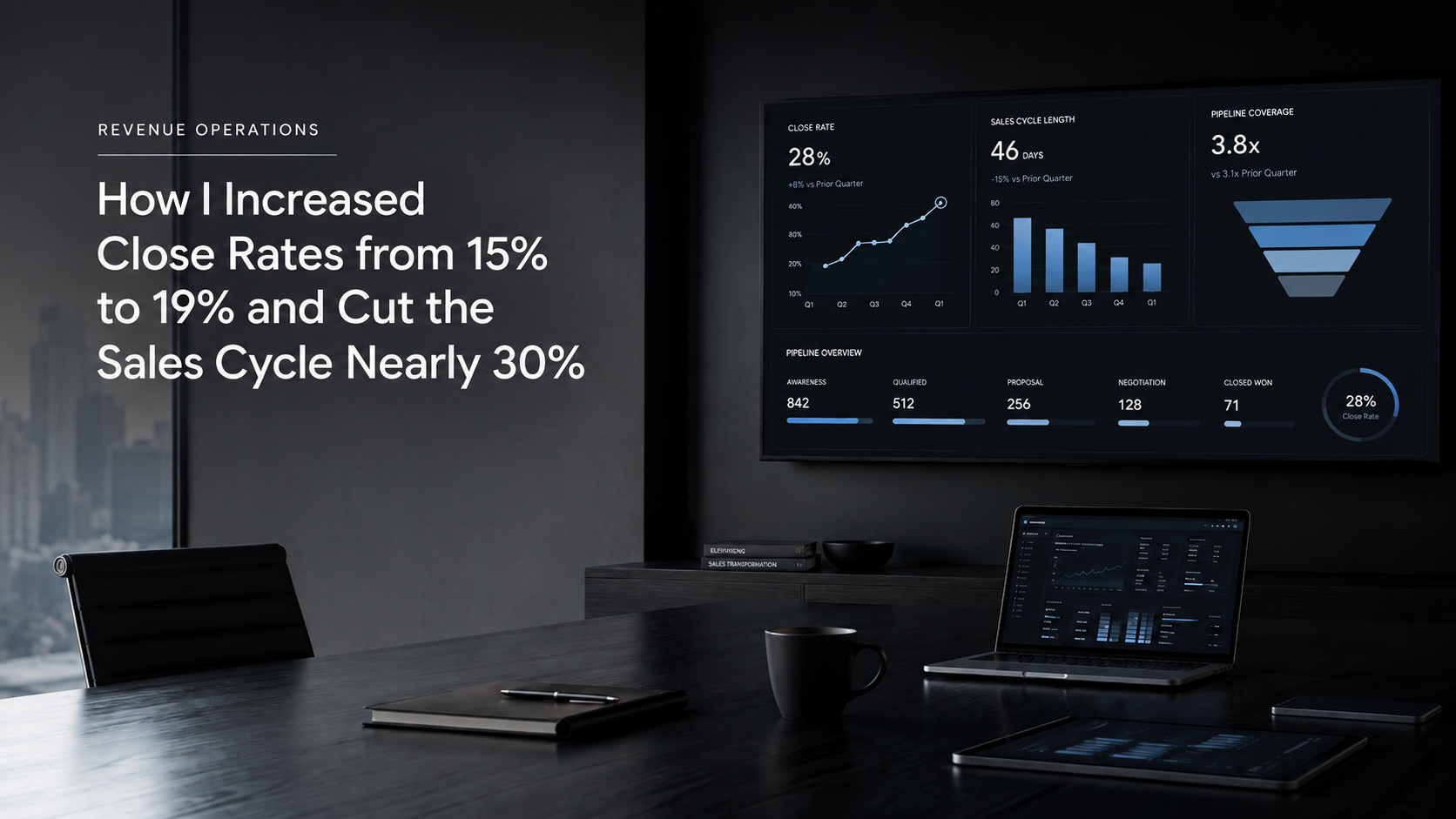
- Close rate: 15% to 19%
- Sales cycle: 92 days to 65 days
- Forecast accuracy: 92%
- Revenue: 150% year-over-year growth
Those metrics helped us see where deals were getting stuck and where the process needed to improve.
We Were Measuring the Wrong Things
The team was logging more than 400 calls a month and carrying a large pipeline.
But only 15% of qualified opportunities were closing.
There was also too much judgment involved in moving deals through the funnel. One salesperson might consider a deal ready for proposal while another would still consider it early stage.
That made coaching inconsistent and forecasting harder to trust.
We needed clearer definitions and a better way to measure what was actually happening.
Start With Three Metrics
We continued tracking calls and pipeline, but they were no longer our primary measures of performance.
1. Close rate
We defined close rate as closed deals divided by qualified deals.
That meant we first had to agree on what “qualified” actually meant.
For us, an opportunity needed:
- Confirmed budget
- Decision authority
- A real business problem we could solve
If one of those pieces was missing, the opportunity was not ready.
2. Sales cycle
We measured the sales cycle from deal creation to close.
We did not reset the clock if a deal stalled in legal, procurement or somewhere else. If it took 92 days, it took 92 days.
That gave us a much more realistic picture of how long deals were taking.
3. Deal quality
We also looked at how much work happened after the initial proposal.
Negotiation is normal. But repeated changes, rework or price discussions can be a sign that something was missed earlier in qualification.
Put More Discipline Around the Funnel
Tracking the numbers was only part of the change. We also tightened the rules for moving a deal forward. Before an opportunity reached proposal, we wanted to know:
- Is the budget confirmed?
- Has the customer clearly explained the problem?
- Is the right decision-maker involved?
- Is there a real timeline?
If the answer was no, the deal stayed where it was.
Managers were accountable for the process too. Every Monday morning, we reviewed close rate by rep, cycle time by stage and deal quality.
There was some resistance at first. That is normal when you add more structure to a sales organization. But the reason for the change became clear pretty quickly.
A higher close rate meant more revenue from the pipeline we already had. A shorter sales cycle meant deals moved faster and forecasts became more reliable.
It also gave managers something specific to coach against instead of simply telling people to make more calls.
A Smaller Pipeline Was Actually Better
One of the first things that happened was our reported pipeline dropped about 30%.
That initially looked bad.
But we had not lost 30% of our opportunities. We had removed deals that did not have confirmed budget, timing or a realistic path to close.
The pipeline became smaller, but much more useful.
Reps also had more time to focus on opportunities that had a real chance of closing.
What Changed
Close rate moved from 15% to 18% by month four and reached 19% by month seven.
The average sales cycle dropped from 92 days to 65 days.
Forecast accuracy reached 92% during the period we measured.
Within a year, revenue grew 150% year over year.
I would not attribute that growth to three metrics alone.
What changed was our visibility into the sales process. We could see problems earlier, coach against specific issues and spend less time on opportunities that were unlikely to close.
What I Took Away From It
One thing this experience reinforced for me is that a sales problem is not always a people problem. Sometimes the team is working hard. The problem is that managers cannot clearly see where the process is breaking down.
That is why I tend to start with a small number of useful metrics rather than adding more reports. I also use Sandler methodology because its qualification discipline fits this approach well.
A deal should not move forward just because everyone feels positive about it. There should be evidence that the customer has a real problem, the budget exists, the right decision-maker is involved and the timing makes sense.
That sounds basic, but it can make a significant difference.
Where I Would Start
If your sales team is busy but revenue is not moving, pull the last 90 days of data and look at:
- Qualified opportunities versus closed deals
- Average days to close
- Where deals spend the most time
- How often proposals require major rework or negotiation
If I had to choose one place to start, it would be close rate. Define exactly what a qualified opportunity means for your business. Apply that definition consistently across the team. Then use the numbers to guide coaching and forecasting.
I have used this approach in landscape technology, commercial manufacturing and consumer products.
The sales environments were different, but the lesson was the same: once you can clearly see where the process is breaking down, it becomes much easier to fix.